To love something, you have to understand it. You cannot be a foodie without a profound appreciation for how food is grown or raised, what was done to it before transportation, where it came from, and what myriad of factors made it possible for it to reach your table.
Journalist and author, Michael Pollan, has written two best-selling treatises on our complicated relationship with the things we eat: "The Omnivore's Dilemma" and "In Defense of Food". He has articulated the guilt, confusion and desires that direct our diet in Western society. We suddenly find ourselves trapped in a situation where "what's for dinner?" becomes a minefield of ethical, socio-economic and biochemical issues.
Organic, pesticide-free, free-run, free-range, gluten-free, lactose-free, peanut-free, trans-fat free, monounsaturated fats, non-fat, low sodium, low carb, low cholesterol, omega-3, vitamin-enriched, calcium-enriched, unbleached, baked instead of fried, vegetarian instead of carnivore, vegan instead of vegetarian, heirloom or hybrid, processed or fresh, wild or farmed, local or imported, and on and on and on it goes.
The innocence of a simple peanut butter and jelly sandwich on white toast is long gone. The peanut spread could potentially kill someone with nut allergies. If the peanut butter isn't organic, then it may have been made with "bad" fats to keep the natural oils from separating. The jelly might have been made from fruit that was exposed to pesticides and sweetened with white refined sugar. The white bread was made from bleached flour. Blackened edges of the toast may introduce carcinogens into your system. The fuel expended to truck the jelly from a factory across the border may have contributed to global warming and skyrocketing gas prices. If you're not killing yourself with your dietary choices, then you're killing the planet.
Foodies are to blame for certain excesses and practices that are questionable, at best. They have a taste for exotic ingredients like pink Himalayan salt that need to be shipped at great expense from far-flung places. They help drive up food prices by insisting on consuming at the same rate, regardless of whether resources are scarce or plentiful. The lust for foie gras perpetuates the controversial practice of gavage -- the force-feeding of ducks and geese to fatten up their livers -- which has been described as "harmless", "cruel" and everything in between. To produce a pound of the pricey and much-revered saffron, 50,000 to 75,000 saffron crocus flowers need to be harvested; yet its role in cuisine is only to impart color and aroma to dishes -- its taste is nothing to write home about.
I conveniently switched to the third-person "they" in the last paragraph, but I am in fact a member of this epicurean clique. I eat meat. Foie gras is absolutely delicious. There are four types of salt in my pantry, and not one of them is the cheap, iodized kind. I allow myself to splurge on exceptional cuts of meat from time to time. Gorgeous olive oils imported from Italy make my eyes sparkle.
Sometimes all this extravagance and preciousness seems all for naught. Once, I ventured to buy a fragment of the extremely rare white truffle from Pusateri's to make a white and black truffle risotto dish for friends. The store manager was obliged to personally escort me and my truffle -- gently nestled on a bed of tissue paper in a box -- to the cash. The gum-popping cashier was impressed by the drama, but had never heard of my little "diamond of the kitchen" (quoting Jean Anthelme Brillat-Savarin). I explained that it was revered for its intense aroma and offered her a whiff. I might as well have farted in her face.
The risotto was elaborately prepared over days and the final result was to die for, if I may say so myself. Can I justify it? I'm not sure. But I would do it again.
For one thing, the fussiness and endless appetites of foodies create the demand for organic, sustainable, local farming. Produce tastes better when grown without the tampering of synthetic chemicals. Shorter distances between farms and customers make it possible to deliver food that is still vibrantly fresh while leaving a smaller energy footprint. Meat is more tender and nutritious when it comes from a happy animal that has been scampering around in the sun and fattened up on a good quality diet. Eggs that come from free-run chickens are bigger, and when you crack'em, the yolk is bright, firm and bulging with goodness.
Nose-to-tail eating is the practice of using every last piece of an animal slaughtered for consumption. This is a practical, ancient approach that dates back to our hunter-gatherer days, but it had fallen out of favor in modern times with the Chicken McNugget crowd. Celebrated chef Fergus Henderson of the St. John Restaurant in London, chef Martin Picard of Restaurant Au Pied de Cochon in Montreal, and writer/farmer/activist Hugh Fearnley-Whittingstall of the River Cottage in Dorset are just some of the high profile gastronomes who have been re-introducing the world to all the other edible animal parts like ears, tails, feet, tripe, sweetbreads, and cheeks. These movers and shakers have a healthy respect for all creatures that makes them loathe to let the sacrifice of an animal go to waste.
In the end, I think what matters is to always have an awareness of what you are eating. The title of William S. Burrough's novel, "Naked Lunch", refers to "a frozen moment when everyone sees what is at the end of every fork". That frozen moment should last a lifetime.
Friday, October 31, 2008


Tuesday, October 28, 2008
H for Hunger
 On Oct 27th, I attended Henry Rollins' spoken word show -- the Toronto stop of his Recountdown 2008 Tour. I've had the privilege of hearing him speak numerous times, both live and in recordings. Witnessing his evolution as an orator and as a human being over the last two decades has been stirring and awe-inspiring. Rollins' self-deprecating sense of humor and storytelling ability have won him many fans, but it is his tireless and sometimes manic social activism that has garnered him respect.
In his performance, Rollins discussed his recent involvement with "H for Hunger", a furious one-man rant/documentary that rails against world hunger and all its contributing forces. It is an English-language remake of "F Comme Faim" starring French actor, Dominique Pinon. Naturally, Rollins was cast as the angry mouthpiece; he also helped finance the project. The film has not yet been released, but I believe it is on the festival circuit now and will hopefully hit your local cinema soon.
Talking about hunger and famine is likely to be unsettling in a blog that celebrates food. First and foremost, eating is a survival mechanism, and it is only when people have the luxury of being picky about their next meal can we begin to talk about cuisine and gourmet dining. There's no difference between foie gras and Spam to someone who is starving to death.
However disturbing the subject is, it can't be ignored. Chronic hunger is omnipresent and caused by a variety of factors. Poverty, of course, is an immediate contributor. Overpopulation in a region ravaged by drought or a disaster leads to a regional shortage of food supplies. Warfare and military policies in certain countries have had a debilitating impact on food distribution and general living conditions. It's important to remember that hunger exists not only in the Third World but in the First World as well.
The treatment of acute malnutrition is not as simple as handing out sandwiches. When the human body has been severely deprived, it has great difficulty processing regular food. The restoration of nutrition needs to occur gradually and gently through therapeutic feeding. Treatment begins with a nutrient-enriched milk then moves on to a specially formulated porridge. These foods are designed to encourage rapid weight gain without taxing the atrophied digestive system.
What is it like, that moment when food is finally delivered to a mouth in desperate need? There's a story from the Japanese film, "After Life" which comes to mind: a World War II veteran recalls his capture by American soldiers after his platoon is decimated. There was not much point to it, given that he was already on the verge of death from disease and starvation. Out of pity, his captors offered him some rice seasoned lightly with salt. The intense deliciousness of the rice at that moment is the one memory above all others that the veteran chooses to take with him to the after life, where he will spend an eternity reliving it.
The value of food to the hungry is evident, but the power of food to nurture and comfort goes far beyond hunger. So, is it obvious or surprising that the most passionate of foodies are among the most active advocates of hunger relief programs?
The United Nations' World Food Programme (WFP) -- which provided support to the "H for Hunger" project -- challenged top chefs around the world last year to raise global awareness by incorporating corn soya blend (CSB) in stunning gourmet creations. CSB is a cheap, vitamin-enriched substance reminiscent of gruel that humanitarian aid workers distribute to disaster-stricken, war-ravaged regions. Much to WFP's astonishment, chefs signed up in droves. Heinz Beck, the executive chef of La Pergola restaurant in Rome (rated two Michelin stars), participated in the challenge and had this to say:
Restaurants Against Hunger (RAH) is a coalition of UK chefs, restauranteurs, food critics, food writers, and others in the food services industry who have banded together to raise funds for Action Against Hunger UK (AAH UK), a non-profit humanitarian organization with the mission to combat hunger and famine.“For us chefs, it’s important to recognize that there are many people who are not able to afford to pay for even bad food... It’s not just a responsibility that we recognize world hunger, it is a duty as propagators of culinary art that we make sure even our most discerning clientele are aware of the problem of famine.”
RAH has innovative means of raising money. For example, member chefs can designate a dish from their respective menus to collect the proceeds from its sale on behalf of AAH. On October 19th, RAH hosted a fundraiser called Too Many Critics: notable food critics prepared a five-course banquet for a dining hall full of distinguished chefs. Hand-decorated plates by Heston Blumenthal, Gordon Ramsay and Fergus Henderson (gasp! gasp! and gasp! a veritable trifecta of culinary awesomeness, in my opinion) were auctioned off that evening to raise a stunning £2,800 (that's almost $5,500 CAD, folks).
Good food is the nectar of life and it should be a fundamental right for everybody to have it within their grasp. If the cookbook ever gets published and does reasonably well, I think the proceeds should go to one of these programs where they do so much amazing humanitarian work. Better keep at it, then!
Sunday, October 26, 2008
Playing With Food for Halloween
 This year's Halloween will be the first one I'll be spending at a home to call my own. I considered turning off all the lights and either hiding out in the back of the house or making plans to go out in order to avoid marauding, candy-intoxicated kids.
However, I've been trying to connect with my anti-social neighbors since moving in. Given that almost every household on the street has kids, it seems opportune to stay home and chat with the costumed children and their parents as I hand out the treats.
To do this, I need to put a hint outside the house to indicate that my place is open for business. Dollar stores are abundant with cheap decorations (already on sale since Labor Day). Yet I abhor the idea of cluttering my closets with useless junk afterwards, especially since I've been trying so hard these last few years to streamline my possessions.
 And so, I came to the ambitious conclusion that I would carve a pumpkin. I didn't want to do a boring Jack O'Lantern with triangle eyes, nose and chunky block teeth. For a while I was hung up on the idea of carving the creepy dead boy from "The Grudge" (or 呪怨) since it's Japanese and definitely eerie. But if you've never seen the movie, I suppose a sullen-looking kid on a pumpkin won't make any sense.
After much deliberation, I finally opted to carve Jack Torrance from Stanley Kubrick's "The Shining". The scene in which Jack (played by Jack Nicholson) tears through the bathroom door with an axe and maniacally growls, "Heeere's Johnny!", is iconic. For those of us old enough to have seen the movie, it is definitely more scary than any mummy, goblin or witch.
It took around 6 hours to carve, using sculpting tools. I was worried that it wasn't going to turn out right because it doesn't look the same without a light inside the pumpkin. However, I think the results were successful... what do you think?
Monday, October 20, 2008
Creeping Doubts
Whenever I'm writing, there always comes a time when I start to wonder why I bother at all. Like the saying goes, if a tree falls in a forest and no one is around to hear it... Or if a blog or book has no readers, does it, should it exist?
Sunday, October 19, 2008
The Inimitable Pepin
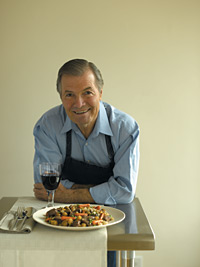 The TV program "At The Table With..." on the Food Network recently featured chef Jacques Pepin. It didn't tell me anything I didn't already know about him, having read his delightful autobiography, "The Apprentice: My Life in the Kitchen", and watched his cooking shows on PBS for close to two decades. But it echoed all the admiration and appreciation I have for the man, in the heartfelt testimonials from family, friends, colleagues and fans. I'm Joe Schmoe on the culinary map, but the top chefs of the world are as awed as I am by Pepin's mastery of the kitchen and -- more importantly -- his humility and eagerness to teach anyone who wants to learn how to cook.
I've always had the good fortune of being surrounded by people who cook exceptionally well, but (with all due respect to you guys) I have to say that Jacques Pepin is my biggest culinary influence. I've always had a roly poly frame so of course I've always been fond of eating, yet it is Pepin who made me want to be in the kitchen, making the things I like to eat.
The vast scope of his career should be humbling to anyone. Unlike the hot shot chefs of today whose career doesn't even begin until he or she enters a culinary school in early adulthood (and graduates in a mere 4-6 years of formal training), Pepin has been working in kitchens since 1947 at the age of 12.
It should be pointed out that the commercial kitchens of that era make Gordon Ramsay's Hell's Kitchen look like kindergarten. Pepin spent his teens working up the hierarchy of the old school brigade system, starting as an assistant, commis, then chef de partie in every single station (including saucier, rotisseur, entremetier, and so on), before moving on to sous chef then finally chef de cuisine. He would have to single-handedly peel hundreds of potatoes or artichokes for each dinner service, night after night, and learned classic French recipes through osmosis because none of the recipes were written down for him. He eventually became the chef for various heads of state and worked the top restaurants in France.
Is it any wonder that he can deftly debone an entire bird in under 30 seconds (all the while talking to his audience)? Or finely minces a garlic clove to a paste with a knife in the blink of an eye? Or manually whisks egg whites into stiff peaks for a meringue faster than an electric mixer? Watch how beautifully and effortlessly he segments a whole chicken into seven pieces for cooking.
His technical prowess aside, the real reason why the public loves Jacques Pepin is his ability to make cooking accessible and the complete lack of egotism in the way he teaches. In a curious twist of fate, it was a near-fatal car accident that sidelined his grueling restaurant career and began his television career as a teacher. Pepin himself considers this a blessing in disguise: it gave him a heightened appreciation for life and the ability to reach millions with his message that anyone can cook (the theme shared by the film, "Ratatouille").
And teach, he does. Most of the culinary tips and tricks I know have come from Pepin. Even if he explains it only once, he has the ability to make it stick in your brain. I learned how to cook a hard-boiled egg without the green sheath of sulphur forming around the yolk. I learned how to chop onions without my eyes tearing up. I learned how to debone a salmon steak and turn it into a neat round of flesh ready for cooking. He was the first person to show me how to deglaze a roasting pan and not let anything go to waste in a recipe. Even the importance of tying an apron in front of you was something I picked up from him.
I owe him my deepest gratitude for all that he has given. His lessons will stay with me for the rest of my life.
Saturday, October 18, 2008
Green Infatuation
 The last time I wrote about tomatoes, I mentioned that I've always wanted to try Fried Green Tomatoes. Of course, many people are familiar with either Fannie Flagg's book, "Fried Green Tomatoes at the Whistle Stop Cafe" or its tear-jerking movie adaptation. Both are responsible for bringing worldwide awareness of the eponymous dish.
Some Googling confirmed for me that the recipe does indeed call for green, unripe tomatoes rather than the tomatillo fruit. In northern climates such as ours, green tomatoes are ready for harvesting in October -- right now! -- but in the south where this recipe originated, green tomatoes are available year round.
Imagine my excitement when I found Ontario green tomatoes at the neighborhood grocery. I ran home and made some batter right away, mixing flour, finely ground cornmeal, salt, pepper and milk (lactose free, in case you were wondering). Tomato slices were dredged through the batter and fried for a few minutes on each side in a skillet with oil.
 It was love at first bite. I've never tasted anything like it before. The green tomato by itself is crispy and tart, like a green apple. But when softened by the heat and enveloped in the sweet batter -- the sweetness coming from the cornmeal and milk -- the residual tartness blooms into something more delicate, more mellow. My instinct was to season it with a modest sprinkling of salt.
 I also found myself wishing I had some sour cream, crème fraîche or something cool and alkaline to complement the tomato. As it turns out, the Juliette, GA cafe where the movie was filmed is now calling itself the "Whistle Stop Cafe" and serves its own version of fried green tomatoes with a selection of dips.
For as long as green tomatoes are around this season, I'd love to keep making this dish. There's room for experimentation with the batter and accompanying condiments. Dredging the slices in egg then in a dry mixture could yield a crisper, less oily exterior. Japanese panko would make it more like a tempura batter. Using more cornmeal would make the batter more crunchy. Herbs and spices in the batter would be fun too. Stay tuned.
A Family Thanksgiving
It is already a week after Canadian Thanksgiving, but I thought I should still share the holiday meal with you.
A major holiday + a family gathering = a heightened expectation of culinary effort. Let's face it -- the traditional Thanksgiving dishes that people make have nothing to do with taste. If we loved it so much, we'd be making it and eating it all the time. I don't know anyone who makes cranberry sauce on a regular weeknight "just because". (Though I might do it now just because I mentioned it.)
This year was different: for the first time since I moved to Toronto, my parents came to visit me for Thanksgiving weekend. However, I did not have the benefit of being in the kitchen all day to prepare. We had a packed itinerary scheduled for the day and I would have a mere hour or two to make something reasonable.
I racked my brain for several weeks over this conundrum. It was clear that the menu would hinge on the choice of the main protein. Roast turkey was obviously out of the question. Turkey breast was briefly considered until I admitted to myself that I'm not in love with turkey meat anyway. Beef, chicken and pork seemed too pedestrian. Quail and duck came to mind but neither are easy to find around here (and they're definitely not cheap).
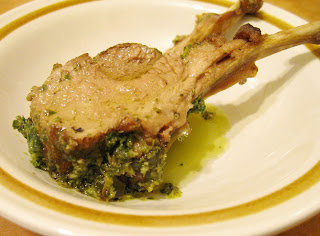 Lamb is not your everyday meat but it's readily available at the local supermarket. It has symbolic significance in numerous cultural and religious contexts as literal show of thanksgiving for the sacrifices that make it possible for us to celebrate life. I was inclined to go with the lamb, but it was a risky choice given that I couldn't recall a single instance in which my family ate it at home. Lamb is completely absent from Japanese cuisine. Detractors complain that it is too gamey, and depending on the dish, I agree with that assessment.
Nevertheless, the final choice was to pan-sear then roast two racks of lamb with lemon gremolata rubbed on them. Gremolata is an Italian condiment, much like pesto, which consists of lemon peel (fresh or preserved), garlic and any choice of herb (I used flat-leaf parsley) pureed with olive oil.
While I grappled with the choice of meat, I also struggled to come up with the sides and dessert. Mashed potatoes take a lot of time and are better made fresh. I did not have time to make pumpkin pie either and this too would suffer in taste if made ahead of time.
I finally decided that if I was going to be unconventional in my choice of meat, then I would deconstruct the rest of the menu as well.
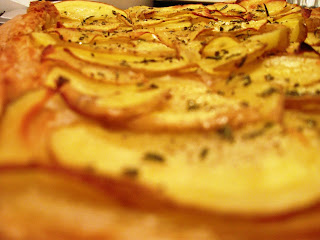 For the starch, I decided to make a "patate pizza" from Marie Claire's "Easy" cookbook. It consists of puff pastry, thin slices of potato, olive oil, chopped rosemary and freshly ground salt and pepper. The Marie Claire version calls for pizza dough, but puff pastry seemed easier to me. If you're wondering how I made puff pastry in a time crunch... I didn't. There is no shame in using frozen puff pastry (Tenderflake is an excellent product) to cut down on cooking time.
For the vegetables, I simply sliced some eggplant and zucchini and placed them in the same roasting pan as the lamb, but under the rack to absorb the flavors from the meat.
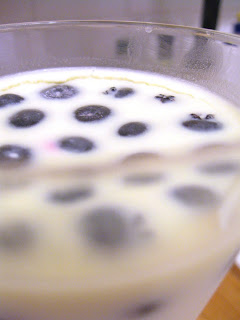 I was really hung up on a pumpkin theme for dessert but conceded that I could not get it done in time. There was a Blueberry and White Chocolate Mousse recipe in Donna Hay's "The Instant Cook" that always caught my eye and it looked light enough to offset the heaviness of the meal. I was able to make it quickly the night before and allowed it to set overnight in a champagne flute. It calls for heavy cream to be whisked in with melted white chocolate and gelatin. Yes, it's a dietitian's nightmare but once in a while, you have to let yourself indulge in something as sinful as this. It looks innocent enough with its fluffy white texture.
A major holiday + a family gathering = a heightened expectation of culinary effort. Let's face it -- the traditional Thanksgiving dishes that people make have nothing to do with taste. If we loved it so much, we'd be making it and eating it all the time. I don't know anyone who makes cranberry sauce on a regular weeknight "just because". (Though I might do it now just because I mentioned it.)
This year was different: for the first time since I moved to Toronto, my parents came to visit me for Thanksgiving weekend. However, I did not have the benefit of being in the kitchen all day to prepare. We had a packed itinerary scheduled for the day and I would have a mere hour or two to make something reasonable.
I racked my brain for several weeks over this conundrum. It was clear that the menu would hinge on the choice of the main protein. Roast turkey was obviously out of the question. Turkey breast was briefly considered until I admitted to myself that I'm not in love with turkey meat anyway. Beef, chicken and pork seemed too pedestrian. Quail and duck came to mind but neither are easy to find around here (and they're definitely not cheap).
 Lamb is not your everyday meat but it's readily available at the local supermarket. It has symbolic significance in numerous cultural and religious contexts as literal show of thanksgiving for the sacrifices that make it possible for us to celebrate life. I was inclined to go with the lamb, but it was a risky choice given that I couldn't recall a single instance in which my family ate it at home. Lamb is completely absent from Japanese cuisine. Detractors complain that it is too gamey, and depending on the dish, I agree with that assessment.
Nevertheless, the final choice was to pan-sear then roast two racks of lamb with lemon gremolata rubbed on them. Gremolata is an Italian condiment, much like pesto, which consists of lemon peel (fresh or preserved), garlic and any choice of herb (I used flat-leaf parsley) pureed with olive oil.
While I grappled with the choice of meat, I also struggled to come up with the sides and dessert. Mashed potatoes take a lot of time and are better made fresh. I did not have time to make pumpkin pie either and this too would suffer in taste if made ahead of time.
I finally decided that if I was going to be unconventional in my choice of meat, then I would deconstruct the rest of the menu as well.
 For the starch, I decided to make a "patate pizza" from Marie Claire's "Easy" cookbook. It consists of puff pastry, thin slices of potato, olive oil, chopped rosemary and freshly ground salt and pepper. The Marie Claire version calls for pizza dough, but puff pastry seemed easier to me. If you're wondering how I made puff pastry in a time crunch... I didn't. There is no shame in using frozen puff pastry (Tenderflake is an excellent product) to cut down on cooking time.
For the vegetables, I simply sliced some eggplant and zucchini and placed them in the same roasting pan as the lamb, but under the rack to absorb the flavors from the meat.
 I was really hung up on a pumpkin theme for dessert but conceded that I could not get it done in time. There was a Blueberry and White Chocolate Mousse recipe in Donna Hay's "The Instant Cook" that always caught my eye and it looked light enough to offset the heaviness of the meal. I was able to make it quickly the night before and allowed it to set overnight in a champagne flute. It calls for heavy cream to be whisked in with melted white chocolate and gelatin. Yes, it's a dietitian's nightmare but once in a while, you have to let yourself indulge in something as sinful as this. It looks innocent enough with its fluffy white texture.
Subscribe to:
Posts (Atom)

 Posts
Posts

